The former Dodgers and Marlins skipper was ready to walk away from baseball after serving as Toronto’s bench coach last season. Dave Dombrowski had other plans.
During a rare off-day in the baseball calendar, Don Mattingly was caught up in mundane tasks—doing laundry and restocking his apartment with groceries—when his phone rang. The caller was Dave Dombrowski, the Phillies’ president of baseball operations. It was the previous Monday, and the Phillies had a 9–19 record. Just two days earlier, the Red Sox had set off the first managerial change of the season by firing Alex Cora. Mattingly had a sense of what was coming.
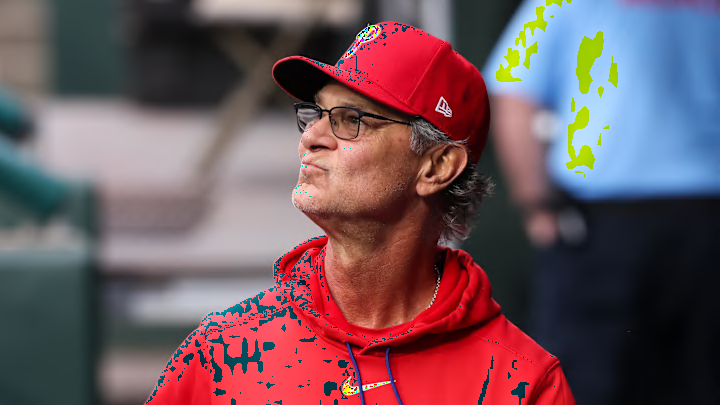
“I’ve been around long enough to pick up on the tension in a place like New York, Boston, or anywhere else,” Mattingly says. “And what happened in Boston had just taken place. You could sense that something like this might happen. So, it wasn’t a complete shock.”
Dombrowski asked Mattingly, who was serving as his bench coach, to take over as manager, replacing Rob Thomson—the man Dombrowski had just let go. The call came only after Cora, Dombrowski’s top choice, turned down the job.
“Obviously everyone knows we wanted Alex, and Alex didn’t want to do it,” Mattingly says. “So when Dave called, I was like, Yeah, I’m in. And it was really that straightforward.”
Just like with Thomson in 2022, the Phillies landed an accidental manager—someone with nothing to prove and no desperate need for the position. Thomson had been ready to leave baseball behind, and Mattingly also had one foot out the door after stepping down as the Blue Jays’ bench coach following Toronto’s Game 7 loss in the World Series, the first Fall Classic he had ever reached.
“I honestly thought all last year, ‘This is it for me,’” he says. “I loved Toronto. I liked the people there, the organization. But I felt like my time there had run its course. It was just time.
“I felt going into the season that it would be the end. So yeah, when the season finished, I thought, O.K., that’s it.”
Then, about two weeks after the World Series, Dombrowski called again. He told Mattingly how well he’d fit in with the Phillies. He didn’t need to remind him that Preston Mattingly, Don’s son, is the team’s general manager. He gave Don all the time he needed to decide.
Meanwhile, Don’s youngest son, 11-year-old Louie, who had thoroughly enjoyed the World Series run, told his father, “You know, Dad, you can’t quit.”
“Oh, I don’t know, Louie,” Don replied.
Don’s wife overheard and said, “Oh, here we go again?”
Ultimately, the answer was yes. The chance was too good to pass up working alongside Preston, seeing his granddaughter, and making Louie happy.
Twenty-eight games into the season, Mattingly the second choice became the accidental manager. He admits he won’t do much differently than Thomson.
“I feel comfortable,” he says. “I’ve spent the whole season trying to think like Thomson. That’s the bench coach’s job—to be in sync with him.”
Having the manager’s job without needing it is a blessing. No scores to settle with a former team. No need to prove anything. No fear of getting fired. No walking on eggshells to keep the position. That mindset served Joe Torre well in 1996 under George Steinbrenner (Torre’s famous line: “What’s the worst that can happen? I get fired? It’s happened to me three times already”). It also worked for Joe Morgan in 1988, Jack McKeon in 2003, and Thomson in 2022.
The Phillies won their first four games under Mattingly, but then a one-hit shutout loss to Miami on Saturday reminded everyone that the team has deep flaws. They lack a cleanup hitter (29th in OPS). The bottom of the lineup is weak. Their hitters chase too much (fifth-most in MLB). The defense is poor (27th in Outs Above Average, worst in batting average allowed on balls in play).
Changing the manager won’t fix those issues. Mattingly is there for the same reason Thomson succeeded Joe Girardi: the team was underperforming and needed a quick fix—a fresh voice—before the season slipped away early. In Mattingly, they have a strong, principled leader who can operate with the freedom of playing with house money.
“I really think I’m a lot like Thomps,” he says, “but I’m not Thomps. I have to be myself. I’m telling the guys what I see, the areas where we need to improve. Emphasizing the details, playing better, sticking together, and fighting. I know the talent is there. It’s not a hard sell it’s not a sell at all. It’s just: Play better. If we play better, we’ll win. And there’s plenty of time.”
The Pirates’ Power Plant
No team throws fastballs like the Pirates. In an era of declining fastball usage, Pittsburgh throws the highest percentage of fastballs (53.1%, excluding cutters), boasts the highest average four-seam velocity (95.9 mph), and allows the lowest slugging percentage on heaters (.353).
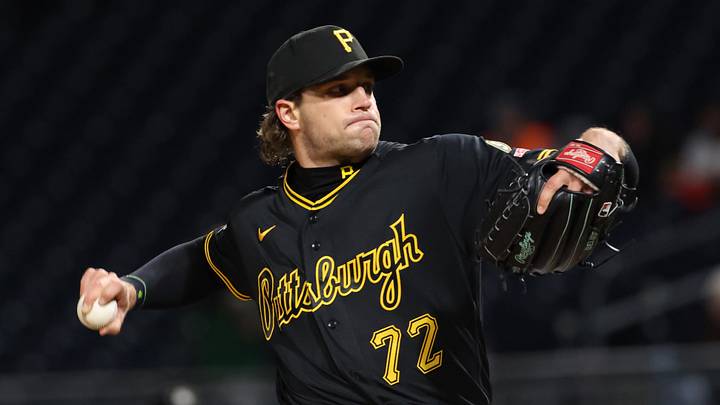
Yes, the Pirates have elite arms like Paul Skenes and Bubba Chandler. Jared Jones is back to throwing 99 mph in rehab outings and could rejoin the team soon. There’s also the emergence of reliever Isaac Mattson, who throws 82% fastballs, plus additions Mason Montgomery and Wilber Dotel, who have hit 100 mph. And then there’s new pitching coach Bill Murphy, who spent a decade in the Astros’ system. Under Murphy, the Pirates have increased their fastball usage from 50.4% to 53.1%.
“It’s about having elite stuff and using it to get ahead,” manager Don Kelly says. “I think it’s just their approach to attacking hitters. I don’t know how much of it is based on the type of fastball each guy has. I’m sure Evan Sisk isn’t throwing as many fastballs as Mason Montgomery.
“What stands out to me are guys like Mitch [Keller], who has been able to manipulate his fastball. He was throwing 95, 96 again on Friday with the four-seamer, but the sinker has been really impressive for him this year. It’s like two different pitches.”
| Pirates’ Pitching Profile | Statistic | MLB Rank |
|---|---|---|
| Fastball Use | 53.1% | First |
| Four-seam velocity | 95.9 mph | First |
| Fastball SLG | .353 | First |
| Fastball BA | .230 | Second |
| Four-seam use | 36.5% | Third |
| First-pitch four-seamers | 475 | Third |
Devers’s Trouble with Fastballs
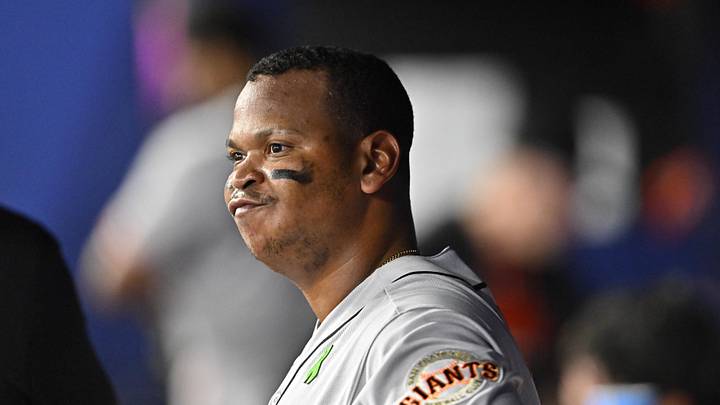
Since being traded from the Red Sox to the Giants, Rafael Devers has appeared in 123 games and posted a batting line of .229/.322/.415—a sharp drop from his .279/.349/.510 performance in Boston. The clearest issue is that pitchers are feeding him fastballs, and he’s struggling to do anything with them.
Devers is seeing 58.2% fastballs (excluding cutters), up from 55.6% the previous year. Last month, the Padres threw him 71% fastballs, against which he managed only a .222 average and no extra-base hits. His whiff rate on fastballs is 36.7%, the third worst in MLB.
He’s especially baffled by harder fastballs. Devers is hitting a career-low .147 against pitches of 95 mph or more, and he hasn’t homered off a pitch that fast since September 28 of last year.
What’s behind the decline? Even at his best, Devers never had a classic swing. His front shoulder rises and opens as he uses his strong hands to bring the bat through, and his stride is long. It’s a lengthy swing that has slowed since 2023 (from 73.4 mph to 71.3 mph) and become more tilted (from 27 degrees to 31). To compensate, he has moved farther back in the batter’s box each year, effectively buying an extra six inches of “time” over the past four seasons.
Back in 2021, the Astros once threw Devers over 50 straight fastballs—more as a tactic than to exploit a weakness. That year, he hit .275 with a .521 slugging percentage against fastballs, solid numbers.
The real trouble began last season, when he hit just .222 and slugged .363 against fastballs. This year has been even worse. His bat speed is declining.
Giants manager Tony Vitello says, “I think it started as a mechanical issue. In spring training, he never found a rhythm. There were two breaks in action.”
Vitello adds that after the team’s ugly season-opening sweep by the Yankees, everyone—including Devers—started pressing.
“He began using his whole body too much in his swing,” Vitello said. “It’s a beautiful swing when he drives the ball to left-center. It’s usually a very hands-driven swing, but now he’s involving his body so much that it’s hard to generate hand speed and have that same control to spray the ball around the field.”
A Devers who can’t hit fastballs and lacks power creates a major gap in a lineup already short on pop. Vitello admits opponents approach his lineup differently when Devers is no longer a feared hitter. Teams attack San Francisco hitters aggressively without worry—no team sees a higher percentage of pitches in the strike zone.
| Most fastballs seen in 2026 (min. 400 pitches) | Percentage | Batting Average |
|---|---|---|
| Luis Arraez, Padres | 62.6% | .321 |
| Isaac Collins, Royals | 62.2% | .241 |
| Rafael Devers, Giants | 58.2% | .235 |
| Cedric Mullins, Rays | 57.6% | .136 |
| Jake Cronenworth, Padres | 57.2% | .220 |
| Devers vs. 95-plus mph | BA | SLG | Home Runs |
|---|---|---|---|
| 2024 | .300 | .722 | 9 |
| 2025 | .222 | .363 | 5 |
| 2026 | ,147 | .176 | 0 |
The Giants struggle both with hitting home runs and earning walks, which is a tough mix. Through their first 33 games, they’re just the third team in the last 91 years to have fewer than 20 homers and under 70 walks.
Less Than 20 HR and 70 BB Through 33 Games, Since 1935
| Team | HR | BB | Final Record |
|---|---|---|---|
| 1964 Mets | 15 | 68 | 53-109-1 |
| 2010 Astros | 16 | 61 | 76–86 |
| 2026 Giants | 19 | 67 |
Seen and Heard
I’m not entirely convinced that the automated ball-strike system is hurting pitchers like Logan Webb or catchers like Patrick Bailey, both of whom had grown used to framing low pitches outside the zone for strikes. In April of last year, the Giants’ pitching staff got 87 called strikes on pitches off the plate. This past April? Eighty-six. Webb, currently with a 4.30 ERA, is actually throwing his sinker and changeup lower than he did last year. The Giants might want to consider starting him more often on four days’ rest, similar to how the Braves handle Bryce Elder. Webb has a career 3.24 ERA on four days’ rest, compared to 3.57 with extra rest. He’s only made one start on four days’ rest this year. Last season, he made 15 such starts, logging 89.1 innings with a 2.92 ERA—only Carlos Rodón had more.
At 20 years and nine days old, Pirates shortstop Konnor Griffin became the youngest player in 52 years to reach base five times and rack up seven total bases in a nine-inning game. Only two players ever did it younger: 19-year-olds Jimmy Sheckard in 1898 and Claudell Washington in 1974.
Kyle Schwarber hit his 350th career home run at age 33. Among the 39 retired players who had reached 350 homers by that age, 24 (or 62%) went on to finish with 500 or more.
Runners weaving into the path of infield throws have become so bold and common that MLB is gathering input on whether a new rule is needed. Midseason rule changes are almost unheard of. For now, the move remains entirely legal—since a runner’s path isn’t fixed until a fielder tries to make a play—and viral clips have turned it into so-called “smart baseball.”
Mariners catcher Cal Raleigh is off to a strange start: despite still having elite bat speed, he’s hitting just .080 against pitches 95 mph or harder. Only Colorado’s Ezequiel Tovar is worse against at least 100 elite-velocity pitches, hitting .045.
As for the Marlins calling pitches from the dugout: Miami is throwing off-speed and breaking balls (not including cutters) 54.1% of the time, the highest rate in MLB this year and the third-highest since Statcast began (behind the 2020 Twins and 2023 Giants).
The Mets have plenty of self-inflicted problems, and the schedule hasn’t helped. In their first 40 games, New York will have crossed a time zone 20 times.
Today’s power hitters are making instant impacts like never before. Nick Kurtz of the Athletics plays his 150th career game Sunday, having entered with 41 home runs. Before 2017, only three players had hit 41 homers in their first 150 games: Rudy York (48), Mark McGwire (46), and Ryan Braun (43). In just the last 10 seasons, seven players have reached that mark: Pete Alonso (48), Gary Sánchez (47), Cody Bellinger, Aaron Judge, Matt Olson, Fernando Tatis Jr., and Kurtz (41).
Breakdown of the Week
Watch out, baseball—Elly De La Cruz is moving closer to his enormous ceiling. The Reds’ shortstop is hitting the ball harder (94.7 mph exit velocity), slugging better (.547), and chasing fewer pitches outside the zone (25%, better than MLB average) than ever. He’s also playing more consistent defense.
“He’s just maturing as a player,” said Reds manager Terry Francona. “He’s moving his feet better. He’s worked hard with coach Freddy Benavides. He’s throwing the ball immensely better this year.”
Before this season, Reggie Jackson (1974), Barry Bonds (1996), and Larry Walker (1997) held the record for most stolen bases (seven) among players with 10 home runs before May. De La Cruz just became the first player ever with 10 homers and eight steals in the first month of a season.
Progress in baseball is rarely linear. But De La Cruz has managed to shorten his swing from both sides of the plate every year—something almost unheard of. Want to know how? He’s shortened his stride, quieted his load, and cleared his hips more efficiently. The result: a violent but compact swing, free of unnecessary length. The bat gets through the zone faster, and the ball jumps harder. The adjustments could lead to historic production, reminiscent of young Barry Bonds and Babe Ruth.
Leave a Reply